
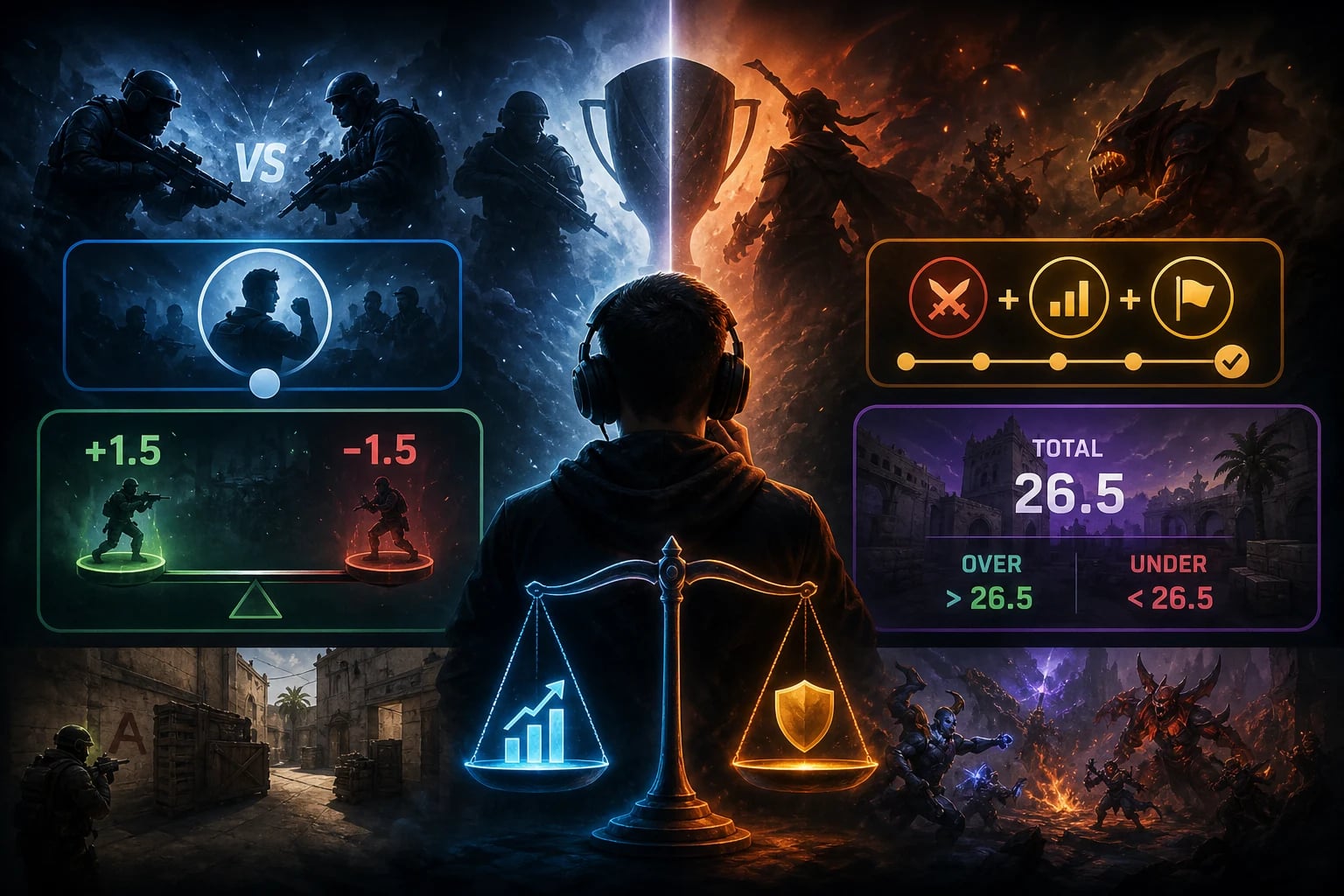
Esports betting is often not such a simple activity. Beginners can get confused, seeing not just "Spirit win or lose," but a multitude of terms, such as -1.5 handicap, 26.5 total, accumulator, individual total, and dozens more. New players often either bet at random or close the tab in fear, but in reality, it's not all that complicated. In this article, NextSport explains the types of esports bets in simple terms.
Win – the simplest market
Before discussing singles and accumulators, it's worth defining some concepts. The market is what you're betting on: win, handicap, total. The coupon format is how you bet: on a single outcome or multiple outcomes. The most straightforward market is series win. You simply choose which team will win the match, and this is usually the starting market, before adding handicaps and totals.
Single
A single bet is a standard single bet: one outcome, one match, and a fixed amount. If you bet 500 rubles on Vitality to win at odds of 1.80 and the team wins, you'll simply receive 900 rubles, and that's it. If the team loses, you'll lose the bet.
Accumulator
An accumulator is a bet that combines several outcomes at once. The odds are multiplied: three events with odds of 1.70, 1.60, and 1.50 yield a final odds of 4.08. It sounds tempting, but there's a catch: all events win, or the entire bet slip loses. This is especially tricky in esports. As sad as it may sound, even a "train" with five favorites often collapses due to one or two unexpected losses. An accumulator bet isn't partly a clever way to beat the bookmaker, but rather a deliberately risky betting format.
Handicap
A handicap is when one team is given points virtually added or subtracted to even the odds. The favorite is too obvious, and the odds for a clear victory are meager, so the bookmaker offers another option.
In a bo3 series, a handicap (+1.5) on the underdog means that a 1-2 loss is often still considered a win: it's as if the team was given one and a half cards to play for. A handicap (-1.5) on the favorite is the opposite: a confident 2-0 victory is needed; a 2-1 scoreline won't do. In CS2, a specific map can have a round handicap: the team (-3.5) must win by at least four rounds (say, 13-9), not just finish the map with any score. The point of a handicap is the difference, meaning you're not betting on "who's stronger," but on one side over the other.
Total
Total is about quantity. It refers to how many maps the opponents will play, how many rounds a map will take, how many kills there will be in CS2, or how many minutes will be played in Dota 2. In bo3, the 2.5 map total works simply: "over" means a 2-1 score is needed, "under" means a 2-0 score is enough. On one CS2 map, the round total indicates how long the match will be: over 26.5 means the game will drag on, under means a quick fight like 13-6. A team can win without the total being reached if the map is played too quickly.
By the way, numbers like 2.5 or 26.5 aren't random. A fractional number rules out an exact match, meaning a refund is impossible: the outcome is always over or under.
The key is not to confuse
Beginners often confuse handicaps with totals, and this is understandable: both markets aren't about a simple win. But the questions for a match are different. Handicaps ask: "Will the favorite win by a wide margin?" or "Will the underdog lose by a landslide?" Totals ask: "Will there be a third map?" or "How many rounds?" For the same match, these are different bets with different logic. In addition to these markets, the line also includes a win on a single map, the exact series score, first blood, and dozens of other outcomes. But handicaps and totals cover most of the non-standard match questions. Finally, it's worth reviewing what we've already covered:
- Single bet — one outcome, one bet, such as a certain amount on a Vitality win;
- Accumulator bet — multiple outcomes on a single bet slip, such as: Vitality loses + 2.5 total + Spirit win;
- Handicap — the margin on the score, i.e., +1.5 means a 1-2 loss is enough, while -1.5 means a 2-0 win is required;
- Total bet — over or under a certain number: over 2.5 cards — a 2-1 score is required, under 2-0 is enough.
Any betting, even esports betting, involves financial risk. We remind you: only bet with money you can afford to lose, be cautious, considerate, and use legitimate bookmakers.