

For a bettor, Dota 2 is not just "another esport." With only one map, a brand-new hero draft every time, patches every couple of months, and matches lasting anywhere from half an hour to over sixty minutes, the bookmakers' line for major tournaments is much deeper than it seems. It includes outrights, map totals, spreads, first blood, match duration, and total kills. Without analyzing the draft and the series format, it is easy to blindly back the favorite and then wonder why they picked Morphling, dropped the map, and threw the game. In this article, NextSport explains how to approach Dota 2 betting from scratch, wager without using martingale systems, avoid throwing together casual "evening accumulators," and ditch the illusion that you can consistently win by placing random bets.
Why Dota 2 is a Distinct Discipline
In CS, half of your prediction depends on the map pool and the veto phase. In Dota 2, the map remains the same, but the hero draft is completely new every single game. For instance, when two top-10 teams clash, they compete not only in raw skill but also in how well they fit into the current patch meta, who got banned, and whose five-hero synergy is stronger. By the way, a new patch in this discipline affects statistics much more heavily than in most other esports.
Naturally, a Bo1 match versus a Bo3 or Bo5 series offers entirely different levels of variance. Furthermore, the kill score often lies if a team has a late-game draft and is simply biding its time during the laning phase. Because of this, it is always better to wager not on "who is cooler and higher in the rankings," but on how the drafted heroes—piloted by specific players on that given day—can overcome their opponents within a set number of attempts.
Where to Start
To begin with, set aside a bankroll that you are completely comfortable losing, and spend only a few percent of it on a single wager. Never double your bet size after a loss (flat betting). Keep a record from day one: match, market, stats, odds, and outcomes. The routine itself is quite straightforward:
- Select a match;
- Analyze the format and rosters;
- Look into signature heroes and drafts;
- Browse predictions and compare them with the bookmaker's line;
- Place a fixed amount.
Markets
For a beginner, standard moneyline (match winner), map totals, or spreads are usually more than enough. The match outcome (moneyline) means backing a specific team to win a single map or the entire series. Over/Under 2.5 totals and \pm1.5 map spreads come in handy when one side consistently sweeps 2:0, or when the underdog is expected to take at least one map. Correct score betting is tailored for those who can calculate or anticipate certain outcomes as the map progresses, which is generally not recommended for beginners.
In-game markets—such as first blood, first tower, total kills, and duration—require a solid understanding of the draft's tempo. An early-game aggressive lineup with a Ursa in lane creates one scenario, a game centered around "waiting for the third Roshan" creates another, while individual mid and carry matchups add yet another layer of complexity. Anything tied to a single map is best analyzed either after the picks are finalized or via live in-play betting with a stream open, rather than guessing blindly before the match starts.
Draft, Format, and Motivation
Rankings are merely a starting point, not the ultimate deciding factor. Look at what a team has been playing over the past two weeks: their actual hero pool, signature carry and mid lane picks, roster playstyle (team fighting, split pushing, early deathball), and how well they fit into the patch meta. For example, after certain heroes are banned, the dynamic can shift much more drastically than the team's current ranking and overall win rate might suggest.
The match format matters just as much as the draft. In a Best-of-1 game, there is a lot of room for variance: underdogs often find it easier to cause an upset, and "safe" 1.20 odds are riskier than they appear. In a Best-of-3 or Best-of-5 series, however, the stronger side has enough time to adapt to bans, mount a comeback, and turn the series around.
Simultaneously, tournament context is key: some teams have already secured a playoff spot, others are on the brink of elimination, someone might be playing with a stand-in, a match could be rescheduled, or players might be forced to sit through a grueling technical pause. Ultimately, if you are placing a pre-match bet, honestly ask yourself: do you know who will be picked or banned, and do you truly understand the likely outcome of that specific draft matchup?
Current Form, Live Betting, and Main Mistakes
Many beginners fail to realize what actually needs to be double-checked before betting on Dota 2. If you want confidence and deep insight, you should look into:
- The last 5–10 series played;
- Not just wins and losses, but the caliber of opponents and match formats;
- Roster changes, like a stand-in in the offlane or at position 4 support, as this can severely disrupt team chemistry;
- LAN vs. Online tournaments — certain rosters perform significantly better or worse depending on the event format;
- Whether a team's level has genuinely improved/declined, or if it was just a couple of easy wins/losses against top-tier opponents;
- Up-to-date regional and global rankings.
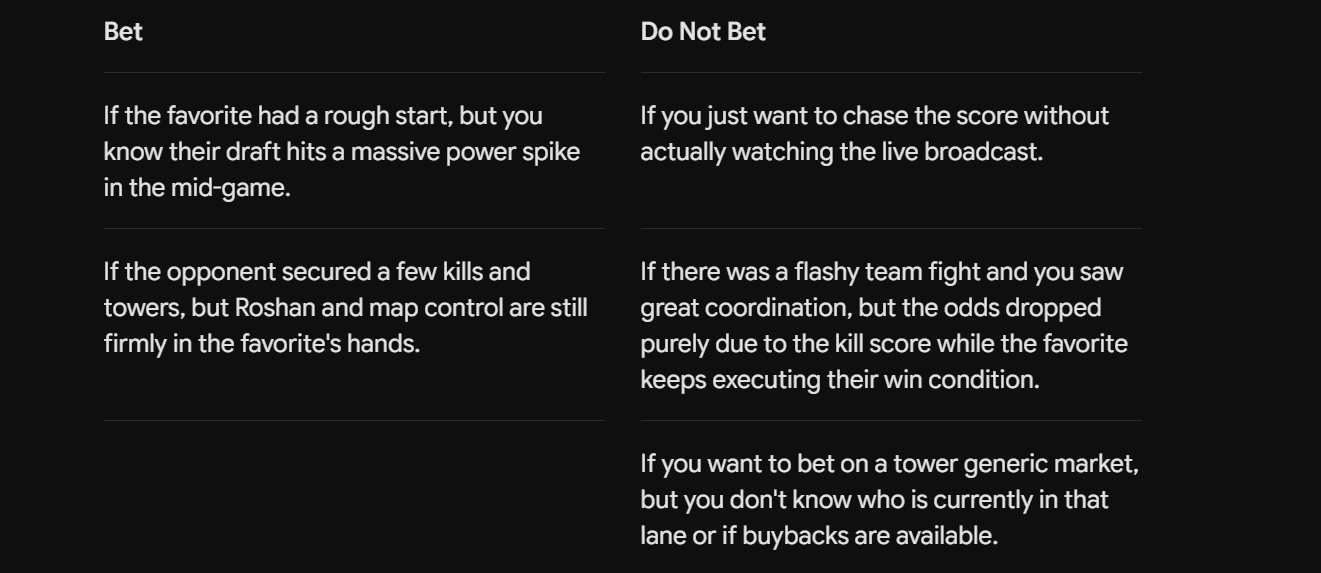
Bettors frequently use platforms like STRATZ, OpenDota, and Dotabuff. Additionally, pay close attention to community casts, match VODs, or data on Liquipedia. Here is a quick reference guide for live in-play betting, highlighting a few crucial aspects: